Showing posts sorted by relevance for query federalist papers. Sort by date Show all posts

The Winds of tyranny


"How much tyranny are you willing to tolerate? When you give your consent to a corrupt government you volunteer to be their slave."

"Those that consent to tyranny lack the courage necessary to live free"


THE CONSEQUENCE & EFFECTS OF HAMILTON'S CORPORATIST/ELITIST/CAPITALIST SYSTEM ON AMERICA, & ITS HIDDEN AGENDA.

How Do We Get Rid Of Obamacare? Nullify It!


We are Americans. We are resourceful. When doors are slammed in our faces, we find another way. Since five (5) lawless judges on the U.S. supreme Court betrayed us by failing to declare the Patient Protection and Affordable Care Act (“obamacare”) unconstitutional; since we may be stuck with obama for four more years; 1 and since a democrat-controlled U.S. Senate will not repeal obamacare, we must find another way.
There is another way. Here it is, and it comes from Thomas Jefferson, author of the Declaration of Independence.

The Federalist Papers


But I am deeply convinced that any permanent, regular, administrative system who...se aim will be to provide for the needs of the poor, will breed more miseries than it can cure, will deprave the population that it wants to help and comfort, will in time reduce the rich to being no more than the tenant-farmers of the poor, will dry up the sources of savings, will stop the accumulation of capital, will retard the development of trade, will benumb human industry and activity, and will culminate by bringing about a violent revolution in the State, when the number of those who receive alms will have become as large as those who give it, and the indigent, no longer being able to take from the impoverished rich the means of providing for his needs, will find it easier to plunder them of all their property at one stroke than to ask for their help.

Alexis de Tocqueville, "Memoir on Pauperism: Does Public Charity Produce an Idle and Dependent Class of Society?" (1835)

The Federalist Papers

The Case for Nullification


Americans who wish to reverse the growing power of the federal government only need to remember that any federal law that is unconstitutional has no legal effect and that the states can stop unconstitutional laws at their borders via nullification.

As the United States of America is manipulated closer and closer to an economic and social abyss, the concomitant consequences of this decline are becoming familiar to all citizens. In fact, many of the youth, whose future is being mortgaged by those determined to perpetuate never-ending war and ever-expanding national debt, are awakening to a sense of this dire situation. And they are recurring to the brief history of our nation to locate a lever for braking the runaway train hurtling toward the ruin of our Republic.

This generation is subjected as none before them to the painful injection of government into every fiber of the body politic. On what seems like a daily schedule, the Congress passes and the President signs into law measures ostensibly permitting the manhandling of people at airports, the suspension of the requirements of due process, and the monitoring by the never-blinking eye of a surveillance state into the virtual and actual behavior of anyone believed to one day possibly pose a threat to the security of “the homeland.”

As they sift among the various legal methods available to them for the civil combat against economic enslavement and the federal government’s intrusions into every aspect of our lives, they have stumbled across a timeless principle of self-defense used by our Founding Fathers to fight their own battle against the forces of federal oppression — nullification.

Simply stated, nullification is a concept of legal statutory construction that endows each state with the right to nullify, or invalidate, any federal measure that a state deems unconstitutional. Nullification is founded on the assertion that the sovereign states formed the union, and as creators of the compact, they hold ultimate authority as to the limits of the power of the central government to enact laws that are applicable to the states and the citizens thereof.

What the Founders Thought

Or, as was so authoritatively explained by Alexander Hamilton in The Federalist, No. 33:


If a number of political societies enter into a larger political society, the laws which the latter may enact, pursuant to the powers intrusted [sic] to it by its constitution, must necessarily be supreme over those societies and the individuals of whom they are composed…. But it will not follow from this doctrine that acts of the larger society which are not pursuant to its constitutional powers, but which are invasions of the residuary authorities of the smaller societies, will become the supreme law of the land. These will be merely acts of usurpation, and will deserve to be treated as such. [Emphasis in original.]

Here, Hamilton (notably one of the Founders often claimed by proponents of an all-powerful central government as their philosophical progenitor) responds to the charges by those opposed to the Constitution, particularly in this instance to the clause in Article VI known as the “Supremacy Clause.” This clause reads in relevant part: “This Constitution, and the Laws of the United States which shall be made in Pursuance thereof … shall be the supreme Law of the Land.”

A plain reading of the black letter of this provision leaves no doubt that when the federal government acts within the scope of its constitutionally established powers, those acts are to be accepted as the supreme law of the land. Or as Hamilton expressed in an earlier letter in The Federalist: “The laws of the Confederacy as to the enumerated and legitimate objects of its jurisdiction will become the SUPREME LAW of the land.” (Emphasis in original.)

The corollary to this clear statement of constitutional distribution of power would be that whenever the federal government enacts laws not provided for in the roster of enumerated powers, those acts are not laws at all. Instead, they are “merely acts of usurpations” and do not merit the respect and adherence due to other, constitutionally sound measures. Put simply, acts of Congress are the supreme law of the land if they are made in pursuance of its constitutional powers, not in defiance thereof.

As if the foregoing weren’t sufficient evidence of the Founders’ view on not only the proper role of the federal government, but of the adherence due to any act perpetrated by it that reaches beyond its limited constitutional grasp, Hamilton wrote very plainly in The Federalist, No. 78: “There is no position which depends on clearer principles, than that every act of a delegated authority contrary to the tenor of the commission under which it is exercised, is void. No legislative act, therefore, contrary to the constitution, can be valid.”

Nullification in Action

Nowhere is the concept and application of nullification more firmly secured to sure footings of constitutionality and morality than in the Kentucky and Virginia Resolutions of 1798 and 1799.

The Kentucky and Virginia Resolutions were terse statements written in 1798 and 1799 proposing the proper response by states to the passage by the federal government of the Alien and Sedition Acts. The drafters of these resolves insisted that as the powers to be exercised by the federal government under the authority of the Alien and Sedition Acts were not given to it in the Constitution, the legislatures of the several states had not only the right but the moral and legal obligation to disregard these acts and brand them as unconstitutional.

After their distribution among the various state governments, it was revealed that the Kentucky and Virginia Resolutions were in truth the product of a collaboration by Thomas Jefferson and James Madison. Jefferson penned the former while Madison wrote the latter.

Although branded by some advocates of a stronger central government as the “infernal plan of exciting insurrections and tumults,” as one can see from the arguments laid out over a decade earlier in the Federalist Papers, these measures were nothing more radical or incendiary than a restatement of well-settled tenets of constitutional federalism. As Thomas E. Woods wrote in his inestimable analysis of states’ rights, Nullification: How to Resist Federal Tyranny in the 21st Century, in the Kentucky Resolution:


Jefferson was merely building upon an existing line of political thought dating back to Virginia’s ratifying convention and even into the colonial period. Consequently, an idea that may strike us as radical today was well within the mainstream of Virginian political thought when Jefferson introduced it.

In order to appreciate the simplicity and sensibility of the proposed nullification of any federal act expanding upon the slate of its specifically delegated powers, one need only read a sample of the resolutions comprising these proposals.

Kentucky’s Resolution 1 declares:


That the several states composing the United States of America are not united on the principle of unlimited submission to their general government; but that, by compact, under the style and title of a Constitution for the United States, and of amendments thereto, they constituted a general government for special purposes, delegated to that government certain definite powers, reserving, each state to itself, the residuary mass of right to their own self-government; and that whensoever the general government assumes undelegated powers, its acts are unauthoritative, void, and of no force; that to this compact each state acceded as a state, and is an integral party, its co-States forming, as to itself, the other party; that this government, created by this compact, was not made the exclusive or final judge of the extent of the powers delegated to itself, since that would have made its discretion, and not the Constitution, the measure of its powers; but that, as in all other cases of compact among powers having no common judge, each party has an equal right to judge for itself, as well of infractions as of the mode and measure of redress.

The second of the Kentucky Resolutions was intended to specifically set forth the legal and constitutional basis for the denial to the Congress of the power to punish crimes not explicitly listed in the Constitution. Congress had assumed this authority, so Jefferson averred, by passing various of the provisions of the Alien and Sedition Acts, which were signed into law by John Adams. Of particular importance is the reliance of this provision on the 10th Amendment. Resolution 2 states:


That the Constitution of the United States, having delegated to Congress a power to punish treason, counterfeiting the securities and current coin of the United States, piracies, and felonies committed on the high seas, and offenses against the law of nations, and no other crimes, whatsoever; and it being true as a general principle, and one of the amendments to the Constitution having also declared, that “the powers not delegated to the United States by the Constitution, nor prohibited by it to the States, are reserved to the States respectively, or to the people,” therefore the act of Congress, passed on the 14th day of July, 1798, and intitled [sic] “An Act in addition to the act intitled [sic] An Act for the punishment of certain crimes against the United States,” as also the act passed by them on the — day of June, 1798, intitled [sic] “An Act to punish frauds committed on the bank of the United States,” (and all their other acts which assume to create, define, or punish crimes, other than those so enumerated in the Constitution,) are altogether void, and of no force watsoever [sic].

In his resolution (there were two Kentucky Resolutions, but only one in the Old Dominion), Madison echoed Jefferson’s reasoning, asserting that the states were justified (in fact, required) in serving as arbiters of constitutionality. The Virginia Resolution took the additional step of labeling as legitimate the interposition of states to the passing by Congress of unconstitutional acts. Madison wrote:


That this Assembly doth explicitly and peremptorily declare, that it views the powers of the federal government as resulting from the compact to which the states are parties, as limited by the plain sense and intention of the instrument constituting that compact, as no further valid than they are authorized by the grants enumerated in that compact; and that, in case of a deliberate, palpable, and dangerous exercise of other powers, not granted by the said compact, the states, who are parties thereto, have the right, and are in duty bound, to interpose, for arresting the progress of the evil, and for maintaining, within their respective limits, the authorities, rights and liberties, appertaining to them.

Similar Spirit

Thankfully, the spirit of Jefferson’s and Madison’s resolutions lives on in several present-day state legislators. As has been reported in The New American, a handful of state and local lawmakers have passed resolutions of their own designed to (in some degree or another) nullify the National Defense Authorization Act (NDAA) and its ostensible grant of authority to the President of the United States to deploy the military to apprehend and indefinitely detain American citizens he suspects of posing some sort of vaguely defined threat to national security.

These courageous men and women are motivated by more than just a jealousy for the sovereignty of states. They understand that there is more at stake than the accurate delineation of borders between the jurisdiction of the states and the federal government. In statements released by these sponsors of state-sovereignty-saving acts, there is expressed an appreciation for the moral obligation imposed upon all Americans to steadfastly demand that the federal government not exceed its constitutional authority.

One of these legislators, when interviewed by The New American, explained the source of his insistence on the securing of the restraints placed on federal power. Speaking of the eternal vigilance that is the price of liberty, Virginia Delegate Bob Marshall said:


You can’t let them get away with exceptions because they won’t stop with one. The procedural guarantees for liberty are there for a reason. Go back in the New Testament. When the Pharisees were trying to find something to charge Christ with, they wanted to catch him violating the Mosaic Code, so they find a woman who had committed adultery and brought her to Christ. We assume that this woman was caught in the act. What did Christ do? He wrote in the sand and said, “Which of you will accuse her?” This is so important because according to Jewish law, you couldn’t accuse another of a crime unless you had clean hands. Any death penalty decree had to be in writing and the Pharisees knew it, but thought they could get away with violating that provision of the law. Christ wrote in the sand, thus fulfilling the requirements of Mosaic due process. The Pharisees probably got the message and we should too. If Christ, who was God, was concerned about due process, we mere humans must be as well.

Turning to Marshall’s fellow Virginian James Madison, we learn that the requirement that the enumeration of powers to the central government be rigidly and faithfully observed is not just laudable — it is that “which can alone secure its [the Union’s] existence, and the public happiness thereon depending.”

Once it is widely understood that any unconstitutional law passed by Congress is without legal effect, then it is easy to accept that the states are uniquely situated to perform the function described by James Madison in a speech to Congress in 1789: “The state legislatures will jealously and closely watch the operation of this government, and be able to resist with more effect every assumption of power than any other power on earth can do; and the greatest opponents to a federal government admit the state legislatures to be sure guardians of the people’s liberty.”

Nullification is commendable principally because its persistent practice engenders trust between the elected and the electorate and encourages the recognition of reliable patterns of interaction between the state and local authorities and the federal government. By consistently demanding that Washington confine itself to its small sphere of influence, everyone — citizen, state lawmaker, U.S. President, and Congressman — knows where they stand and can act knowing they enjoy the good will of those by whom they were chosen to serve.

If the people will not allow deviance from the terms of the compact, then legislators at last will be disabused of their commonly perceived illusion that the people can be easily lulled into a lethargic stupor rendering them unwilling and eventually unable to withstand the steady herding of our nation into the corrals of despotism.

Finally, of all the legal verities and moral virtues of nullification, there is one that sits at the pinnacle of them all. Nullification, as defined by Jefferson and Madison and as being proposed and practiced by contemporary Americans, is a fail-safe protection of popular sovereignty and limited government. Chiefly this is because the keys to these fetters are kept by the people.

A growing number of concerned citizens of this Republic are no longer willing to recur to Congress to repeal unconstitutional laws or to file legal complaints in the hope that the courts will strike down offensive measures. They understand that while perhaps commendable, these tactics are futile and offer no guarantee of the restoration of constitutionally ensured freedom. They refuse to wait on this or that President, this or that Congressman, or this or that political party to acknowledge their pleas for relief from federal oppression. Instead, they unashamedly will assume their right and their duty to derail the “long train of abuses and usurpations” and “provide new Guards for their future security” — the states and themselves.


Posted by Joe Wolverton, II

President Obama’s Abuse of Executive Power


Posted by Joe Wolverton, II

In an opinion article published October 10 in the Washington Post, political commentator George Will describes one of President Barack Obama’s latest “abuses of executive power.” Writes Will:


On Jan. 4, [President Obama] used recess appointments to fill three seats on the National Labor Relations Board (NLRB), even though the Senate said it was not in recess. Obama’s cheeky Humpty Dumpty rejoinder was: I decide what “recess” means.

Now a court must decide whether the Constitution means what it says.

In 2011, the Noel Canning company, which bottles soft drinks in Yakima, Wash., was negotiating a labor contract with Teamsters Local 760. The union says it and the company reached a verbal agreement. The company disagrees. An administrative law judge sided with the union. On Feb. 8, after Obama’s disputed appointments, the NLRB upheld that decision and asked a federal court to enforce it. Noel Canning is asking the court to declare that the NLRB’s intervention in the dispute was unlawful because the board lacked a quorum until Obama made the recess appointments, which were invalid because the Senate was not in recess.

In defense of his controversial and legally questionable appointments, President Obama insists that they were made in complete compliance with the Constitution’s grant of such power to the president in Article II.

Is the president’s interpretation of Article II correct? To answer that question, one must first look to the text being cited as a justification for the appointments.

Article II, Section 2 of the U.S. Constitution states:


The President shall have Power to fill up all Vacancies that may happen during the Recess of the Senate, by granting Commissions which shall expire at the End of their next Session.

The plain language of that clause authorizes recess appointments. If the Senate is in recess, then the president is within the sphere of his constitutionally enumerated powers to fill a vacancy that will be valid until the end of the next congressional session.

An additional analysis of the black letter of Article II makes it clear that the Senate must already be in recess in order for an appointment made in its absence to be valid.

There is no provision in the Constitution even hinting at the right of the president to use trickery to create artificial breaks in congressional sessions in order to forcibly impose his will in defiance of express senatorial opposition to it.

Not surprisingly, the Obama Department of Justice (DOJ) defended the president’s appointments. In a memo dated January 6, 2012, DOJ officials cited various scholarly and bureaucratic interpretations of the so-called Recess Appointment Clause of Article II in order to buttress their opinion:


This Office has consistently advised that “a recess during a session of the Senate, at least if it is sufficient length, can be a ‘Recess’ within the meaning of the Recess Appointments Clause” during which the President may exercise his power to fill vacant offices.

Although the Senate will have held pro forma sessions regularly from January 3 through January 23, in our judgment, those sessions do not interrupt the intrasession recess in a manner that would preclude the President from determining that the Senate remains unavailable throughout to “‘receive communications from the President or participate as a body in making appointments.’

Thus, the President has the authority under the Recess Appointments Clause to make appointments during this period.

In summary, the Department of Justice memo argues that the business conducted by the Senate between January 3 and 23 was conducted pro forma and thus does not qualify as an interruption of the recess begun by the vote to adjourn taken on December 17, 2011.

This argument was echoed in a piece recently published by David Arkush, director of Public Citizen’s Congress Watch division. In his paper, Arkush posits two constitutional pretexts allowing the president to place someone in office whose nomination has already been blocked by the Senate.

First, Arkush insists that Article 2, Section 3, of the U.S. Constitution authorizes the president to force the House and Senate to adjourn. Then, once Congress has obeyed that presidential mandate, the president may then lawfully make a “recess appointment.”

Next, Arkush argues that the 20th Amendment orders Congress to assemble at least once a year, with each session beginning on January 3. Arkush says that in order to be able to start a session on January 3, Congress would have to have ended a previous session, thus leaving a gap between the last session and the current session during which the president may squeeze in and make “recess appointments,” obviating the requirement of senatorial advice and consent.

The Founders felt otherwise. In The Federalist, No. 76, Alexander Hamilton explains that the Constitution “requires” the cooperation of the Senate in appointments in order to “check” the president and “to prevent the appointment of unfit characters”; and that “the necessity of its [the Senate’s] co-operation, in the business of appointments, will be a considerable and salutary restraint upon the conduct of that magistrate [the president].”

Addressing the issues underlying the current constitutional crisis specifically, in The Federalist, No. 68, Alexander Hamilton writes of the Recess Appointment Clause:

The ordinary power of appointment is confided to the president and senate jointly, and can therefore only be exercised during the session of the senate; but, as it would have been improper to oblige this body to be continually in session for the appointment of officers; and as vacancies might happen in their recess, which it might be necessary for the public service to fill without delay, the succeeding clause is evidently intended to authorize the president, singly, to make temporary appointments “during the recess of the senate, by granting commissions which should expire at the end of their next session.

What, then, was the role the Senate was designed to play in the nomination and appointment process? Again, we turn to The Federalist Papers and Alexander Hamilton:


To what purpose then require the co-operation of the senate? I answer, that the necessity of their concurrence would have a powerful, though in general, a silent operation. It would be an excellent check upon a spirit of favoritism in the president, and would tend greatly to prevent the appointment of unfit characters from state prejudice, from family connexion, from personal attachment, or from a view to popularity. In addition to this, it would be an efficacious source of stability in the administration.


Become a member and support the TAC!

A quote from an article published online by the San Francisco Chronicle hints that while the president understands that the Senate has a constitutional duty to check his power, he will not allow the exercise of such to impede the growth of government:


Administration officials have said Obama made the appointments because Senate Republicans have been unfairly blocking Senate confirmation of nominees as a way to limit the power of agencies they oppose.

Despite President Obama’s immeasurable regard for his own moral, legal, and intellectual superiority, not even he is an alchemist capable of turning Senate reluctance into a Senate recess.

The coda to George Will’s Washington Post piece puts the president’s behavior in an apt and timely frame:


The constitutional guarantee of congressional self-governance, combined with the Senate’s determination that it was in session Jan. 4, destroys Obama’s position, which is that he can declare the Senate in recess whenever he wishes to exercise what the Framers explicitly denied to presidents — a unilateral appointments power. Consider this episode when deciding whether on Jan. 20, 2013, he should again have a chance to swear to (only selectively) defend the Constitution.


Is the Constitution in Danger of Becoming Dismantled? (Posted from my Archives from May 5, 2013)


(Above: James Madison, co-author of The Federalist Papers, "Father of the Constitution," and fourth President of the United States, 1809-1817)


On my Facebook, I receive updates from several conservative and Libertarian politicians, journals, and organizations.  Such groups as The Federalist Papers, United Liberty, Sarah Palin, Ron and Rand Paul, and Tea Party Patriots line my feed multiple times per day, and I always get a real charge from reading what they present to their intended audience so long as I am not using my "dumb" cell phone to peruse the site.  The common theme for the majority of these apparatus' is our elected leaders in Washington's adherence to the Constitution, or lack thereof.  As a conservative with Libertarian leanings, I feel it is the Republican party in part and the Libertarian party or movement as a whole who best lean on every word of the fabled document.  The Democrats, unfortunately, wish to disavow the directives of the Constitution and create more of a British  Common Law system whereby they pass legislation without any prohibition by a set list of instructions exercising the rights of men and women.  These Democrats, or liberals as I prefer to generalize them as because there are a few of those in the Republican party who pose as conservatives like John McCain, Lindsay Graham, and Mitt Romney who, in their political careers have taken steps toward increasing spending in government through the usurpation of the American people's constitutional rights, have bastardized the very spirit upon which this nation was founded. Rather than deviate from our British forefathers' legal system that is broad and far reaching, our federalized government systems -- federal, state, and local -- have sought to deny the American people their natural rights of man.  All the political parties during our 225 years under the present Constitution have been guilty of infringing upon these liberties, but none more so than our leftist friends, the Democrats. Yet strangely, the public continues to elect politicians from this political party to public offices.

Bill O'Reilly said it best during Fox News Networks' coverage of the 2012 Presidential Election: the American people want things from the government and are willing to sacrifice their tax dollars and rights to get those things, and that is why they vote for Democrats.  It was none other than Thomas Jefferson who spoke some years before the first socialist and communist economic and political philosophers began to publish their pamphlets when he said:
"I predict future happiness for Americans if they can prevent the government from wasting their labors under the pretense of taking care of them."
It is such logic as this that today's conservatives and Libertarians operate under.  While Jefferson would have no doubt been a Libertarian had he lived today, essences of Jeffersonian political thought trickled down through the ages with the births of the Democratic party under Andrew Jackson, the Whig party, and later the Republican party under Abraham Lincoln.  Even at that, those parties in the early years did not resemble their present-day incarnation, for it is true the Whigs no long even exist.  America would not begin to see more of what would become known today as the liberal and conservative political movements until well into the 20th Century.

In terms of political movements, modern day liberalism was born following Reconstruction, when immigration reached its greatest numbers and many of the migrants who settled the big cities of the North were of rather radical political affiliations that were based on the political atmosphere in their mother countries.  Such movements as the Populists and Progressives gave rise to eventual legislation by such presidents as Theodore Roosevelt and Woodrow Wilson that would reform the working conditions of Americans factory workers as well as invent the modern-day income tax code with the passage of the Sixteenth Amendment. All of this was loosely based on little snippets from Karl Marx's and Fredrick Engels' The Communist Manifesto.  The fear among more conservative lawmakers and political followers of the day was that the raging tide of European political extremists who were also migrants would push for a revolution between the poor working class, or the proletariat, and the middle and upper classes, or the bourgeoisie.  It was during the period from the late 1870's through the end of the Wilson administration that one saw the beginnings of class warfare in America, and it was brought to this continent by none other than European radicals.

With Wilson no longer occupying the White House, Republican presidents Warren G. Harding, Calvin Coolidge, and Herbert Hoover presided over a period of time in America known as the "Roarin' '20's."  America experienced its golden age during the 1920's, and such novels as F. Scott Fitzgerald's The Great Gatsby permeated American culture in defining the life of the wealthy during this period.  However, all of this came to a halt in 1929 when the Stock Market crashed and the Great Depression began.  Four years later, Hoover was voted out of office in a landslide loss to Democratic presidential candidate Franklin D. Roosevelt, who would drastically alter the way government would operate by once and for all transforming the nation into a socialist-welfare state by creating such social programs as Social Security, the Works Progress Association, the FDIC, etc, that were intended to get as many Americans back to work as possible and to bolster the confidence of the population.  Suddenly, government was bigger than it ever was before, but for all the attempts at returning the economy to good times again, Roosevelt was unable to do so until the start of World War II.  It was then that a war economy imbued with the essences of heavy industry re-invigorated society.

Roosevelt passed away in Warm Springs, Georgia in 1945 just before the conclusion of the war.  In his place was Harry Truman, who ushered America and the world into the "Atomic Age" by signing off on an executive order to drop atomic bombs on Hiroshima and Nagasaki in Japan.  The result was total victory in both the European and Pacific theaters of the war.  The unintended consequence, however, was the Soviet Union, who liberated Eastern Europe from the Nazis, worked to build nuclear weapons of their own.  The standoff between the United States and the Soviet Union in Berlin was the beginning of the Cold War.  During this time, the United States taxed its citizens more heavily than it had ever done so previously in order to keep up with the demand for more and better military arms.  Many of Truman's policies proved to be unpopular, and when he left office in 1953, his approval rating was only around 33 %.  In his place came the hero of the European Theater of World War II, Dwight D. Eisenhower.  He was the most conservative political figure to have entered the White House since Hoover in the 1920's and early 1930's.  He also presided over the last combination of Republican party members who controlled both the White House and Congress for over 40 years.  It was while Eisenhower was in office that the Civil Rights Movement began in earnest with the Rosa Parks incident.  After Eisenhower's terms as president expired, the nation became much more liberal like it had been during the FDR days, with the addition of social issues such as civil rights, gay rights, legalizing abortions, and the legal prohibition of the practice of prayer and biblical recitations within public schools.

John F. Kennedy, who succeeded Eisenhower, actually cut taxes and went against the Democratic party's platform to a great extent.  But it was under Lyndon Johnson, Kennedy's Vice President who succeeded him upon JFK's assassination in 1963, that the socialist policies were pushed the furthest they had gone in over 20 years.  In a speech, Johnson spoke of creating what he foresaw would be the "Great Society," a term that terrified Republicans.  It was also during this time when Johnson rammed through Congress the Civil Rights Act of 1964, thus endearing the Democrats to the African-American demographic permanently, and he created Medicare.  Lyndon Johnson's 1964 Republican challenger was Sen. Barry Goldwater of Arizona.  It was Goldwater who gave birth to the concept of modern conservatism in America, but in 1964, the nation was not ready to be led by someone so revolutionary, and he was soundly defeated by Johnson by what was at that time the largest landslide victory in the history of presidential elections.  Though Richard Nixon would be elected President in 1968, he was no conservative, and his successor as a result of his forced resignation due to the Watergate scandal, Gerald Ford, proved to be a truly incompetent leader in the White House.  In 1976, the American people elected Georgia governor Jimmy Carter president, and with both the White House and Congress being controlled by Democrats, more liberal policies would be enacted in Washington.

The Carter administration's high watermark was the signing of the Camp David Peace Accords between Egypt and Israel.  However, it was marred by high unemployment, inflation, and lastly the Iran Hostage Crisis.  He was viewed as an inept leader, and a conservative from the Goldwater school of thought by the name of Ronald Reagan throttled Carter in the 1980 election.  Reagan was the first of the true modern conservative Republican to occupy the White House, and he revolutionized politics domestically and around the world with his brand of conservatism in much the same way FDR had for the Democrats. The eight years of Reagan's presidency are often referred to as the "Reagan Revolution" because he employed a more open- market approach to capitalism, cut taxes across all income brackets by 30%, and ended the Cold War with the Soviet Union through increased expenditures on the military to such an extent that the Soviets could not keep up due to its failing economy.  It should also be noted that Reagan was one of the first notable conservative Republican to take a stand against legalized abortions, which he emphatically addressed with his Mexico City Policy in 1984, and he managed to reduce the rates of inflation and unemployment dramatically while not employing socialist measures that trampled upon the American people's constitutional rights.  Other than his tendency to allow powerful religious figures to influence his policies, Reagan was the greatest president of the past 100 years by many accounts.

With the Cold War over in 1991 with the collapse of the Soviet Union, there still was a Republican in the White House in the form of George H.W. Bush.  However, he broke away from the Reagan formula for success when he was pressured into raising taxes, and it resulted in another recession and over 6% unemployment.  The result was the election of the first Democratic Party member to the White House in 12 years in Bill Clinton.  Clinton would occupy the White House at the same as the Democrats controlled Congress, and the laws passed increasing became more liberal, such as the Brady Crime Bill, the largest income tax hike in history during peacetime, and the infamous "Don't Ask, Don't Tell" law. "Slick Willie" would increase taxes, too, despite his victory over Bush being predicated upon the economic costs of the tax hike in 1990, which ironically was prompted by members of his own party. Americans had enough of Clinton's liberal shenanigans, and in 1994, the Republicans won control of Congress for the first since 1956.  This essentially ruined the Clinton administration's agenda of liberalizing America to the point where eventually a national health service would have come into existence.  In 2000, George W. Bush won the presidency, albeit controversially, over Vice President Al Gore.  Bush would serve two terms in office, cut taxes in 2002, and preside over the nation as it began the war on terrorism stemming from the attacks on September 11, 2001.  Bush's decision to go to invade and overtake Iraq in 2003 proved to be fatal to him politically when it became known that there were no weapons of mass destruction in the country.  Also proving even more damaging to his legacy was the financial disasters of 2008, which led to the election of Barack Obama in 2009 over Arizona Sen. John McCain.  For the first two years of Obama's presidency, Democrats controlled all of Congress, and with the passage of the Affordable Health Care Act (aka. "Obama Care") soon after being elected, Obama's popularity took a steep dip with the drastic rising in unemployment and the federal deficit.  Obama's liberalism, the most extreme since the Johnson administration, cost the nation dearly, and America is still paying for it.  Yet, he was reelected in 2012 when he defeated former Massachusetts governor Mitt Romney.  Once again, like in 2008, the Republican party ran a presidential candidate on a platform that was too similar to that of the Democrats, for Romney actually passed a health care act in Massachusetts during his governorship not unlike what Obama pushed through Congress.  The Republicans have strayed away from their conservative roots that brought them great success during the Reagan administration.  The conservative voters of this country have come to feel disenchanted, and the moderates and undecided voters who are looking for that difference in policy do not find it with the Republican party today, as the party aims to placate to more moderate and centrist voters rather than engaging to please the bread and butter of its following.

So, now you have the brief history of our nation since about 1877.  Most of the trampling on the people's rights have come at the hands of the Democratic party. Democrats, since 1933, have sworn to take care of the American people so long as they get to tax the public as much as they want.  They do, as Jefferson said and I will paraphrase, waste the labors of the people under the pretense that they will take care of them.  With the mass murders of teachers and school children in Newtown, CT, the people's Second Amendment rights are under attack more now than they have been in nearly 20 years despite President Obama having originally promised in his campaigns that he would not attack the amendment.  Furthermore, small business owners face the threat of losing their businesses over the issue of Obama Care because they can not afford to provide the insurance for their employees.  Many businesses have already cut back on labor and their employees hours in order to try to satisfy the requirements as prescribed by the new health care law.  And what of the general public?  The least expensive package of Obama Care will run upwards of $1,000 a month!  The average American cannot afford that!  To make matters worse, none other than Sen. Max Baucus (D-MT) and Senate Majority Leader Harry Reid (D-NV) openly admitted that the implementation of Obama Care will be a "train wreck," and then Reid had the audacity to say that he could fix the problem if they could raise taxes still more! Then, there's the issue of our currency, which has drastically seen a rise in inflation since Obama took office in 2009.  The President ordered the mass printing of dollars to foot the bill for his social programs, and as a result, we have massive inflation. The price of gasoline is at record highs, yet Obama and the Democrats in Congress refuse to open up federal lands to pump oil in order to make the United States more self-sufficient and to create thousands of jobs. There is the immigration issue also, where President Obama is proposing to declare amnesty for all illegal immigrants who cross over into the U.S. from Mexico and other places.  These aliens, who should be illegal but will not be under Obama, will take away jobs that natural born American citizens, and cause greater unemployment when there are too many American citizens looking for jobs and too few to go around; those who do not work but rather remain idol will receive welfare benefits whereas other citizens, naturalized Americans, who truly need government assistance will not be able to get it.  This abhorrent plan to cater to illegal immigrants by granting them amnesty is being done for no other reason than to gain the Democrats more registered voters who will vote them into office.  The unemployment rate still sits at 7.5%, the lowest rate in four years, yet jobs are still hard to come by, and the President, in his infinite wisdom, is attempting to raise taxes, having done so with the Fiscal Cliff Agreement with Republican lawmakers back at the beginning of this year, and he proposed to do so again with his budget he submitted before Congress just last month; it should be noted that while he has proposed all along to raise taxes on the wealthiest 2% of American taxpayers, both times he has either raised or proposed to raise taxes, the middle class and even the poorest Americans were also targets for the hikes.  Lastly, President Obama has more than doubled the federal deficit from where it was under President George W. Bush; it currently sits at $16,803,321,438,273.70!  At what point do the American people grow weary of electing these liberal officials to high office who expand government exponentially, limit civil liberties, and seek to turn this country into a socialist state and instead vote for statesmen who will work to cut federal spending and eliminate Obama Care?  The federal government has not expanded at this rate since the 1960's, yet the American people allow an event such as the financial crisis of 2008 ruin our good judgment on not allowing crooked politicians in high office who will seek to deny them their natural rights as protected by the Constitution by telling such lies as they will care of them monetarily or they will redistribute the wealth more evenly if they vote for them so they can tax the rich more when, unfortunately, it is the middle class who wind up taking it up the rear-end and yet rarely know what hit them.

Former British Prime Minister Margaret Thatcher was fond of saying that there is no such thing as public money. She is correct.  All government programs are funded by we, the taxpayers, under the auspices that the federal government will manipulate the money in such a way as to make it appear that they are helping the poor when, in fact, they keeping the poor poorer in their attempt to make the wealthiest Americans as well as the middle class poor as well.   The real champion of the poor and underprivileged is the Republican party, for it is they who will work to create rewarding jobs out in the workforce rather than rendering them to the government soup ladle.  The Republican party focuses on the individual and not the collective -- it seeks to set the conditions to be right whereby the American worker can thrive, own property, and as a result grow in wealth and prosperity, whereas the Democrats will simply resort to class warfare, raise taxes, and make everyone poorer rather than allowing them to prosper while trying to grow government bureaucracy.  It is the Democratic party who will take your firearms away; who will use drones to spy on segments of the American population just as was done in Louisiana early last month, yet was denied by the Obama administration; it is the Democrats who will deny the people their First Amendment rights; who will, as part of those First Amendment rights; seek to deny the people the liberty of worshiping their religion as they so choose; and lastly, will attempt to manipulate the media into reporting the news as they see fit and crack down on those media outlets choosing to break away from the government line.  The American people have to know the imminent danger they are in when they continue to elect evil men and women like the Democrats, yet they continue to do so blithely.  It is as if the people do not care to have rights, and this is completely against the founding principles of this nation.

Thomas Paine spoke of "common sense" when it comes to matters of a democratic-republican government and living in a just society because of that unique characteristic we have that so many other nations on Earth are not fortunate enough to have ever experienced.  Paine wrote a line that echoes this sentiment very clearly: "From the errors of other nations, let us learn wisdom."  The Founding Fathers, in creating our first system of laws called the Articles of Confederation, took bits and pieces from other Westernized nations throughout history and melded them together to create it.  Unfortunately, it was a total and complete failure, and so it was back to the drawing board. Today, we have more examples of copious democracies across the world for whom we can look at to pattern ourselves after, most notably nations in Europe, Canada, and Australia.  The one thing all of those nations have in common is they are socialist states.  Their people are not blessed with the same rights we here in the United States have been over the course of more than 200 years.  Those governments are imbued with essences where, as columnist Noelle Campbell wrote in her article titled "What Happened to Common Sense?" on the website called The Federalist Papers, we have become so reliant on rules, laws, regulations, minimum standards, etc., that they are now conditioned to not think at all, but rather to follow a series of rules.  Sadly, this phenomena has been occurring in the United States now since the FDR administration, which was when America became a socialist-welfare state, and the laws have only grown more numerous and cumbersome since then.  The Constitution has within it a prescribed set of checks and balances; it also provides the government ammunition to amend the document should a disagreement arise to the severity that it would otherwise bring cause to dissolve it and start all over.  Yet, the liberals in this nation have set out to transform this political system into something resembling the British one, whereby the government has no real constitutional doctrine but rather it passes legislation based on a "common law" system of traditions that go back hundreds of years.  The liberals want the United States to become like Europe, where taxation is high, the government controls the majority of the means of production, and the government can regulate the populations collective salary by income redistribution.  Most of all, the liberals wish to not only trample on the American people's natural rights as guarantee by the Constitution, they wish to dissolve the document once and for all.  Frankly, I am fearful this may, indeed, happen.

As a registered voter, I will never vote for a politician who will sacrifice the principles the Constitution was founded upon.  That means I will never vote for a Democrat.  Sadly, other people will, and it is these people who are leading this nation down the path to perdition.

Words of wisdom : Citizen Tom


DO YOU BELIEVE MAN CAN PERFECT HIMSELF?


When America still considered itself a Christian nation, Americans knew better than to trust in the ambitions of their fellow men. They understood something about the temptations of their own pride.

Who Is Proud?

Consider this story told by Jesus.
Luke 18:9-14 New Century Version (NCV)
Being Right with God
9 Jesus told this story to some people who thought they were very good and looked down on everyone else: 10 “A Pharisee and a tax collector both went to the Temple to pray.11 The Pharisee stood alone and prayed, ‘God, I thank you that I am not like other people who steal, cheat, or take part in adultery, or even like this tax collector. 12 I fast twice a week, and I give one-tenth of everything I get!’
13 “The tax collector, standing at a distance, would not even look up to heaven. But he beat on his chest because he was so sad. He said, ‘God, have mercy on me, a sinner.’ 14 I tell you, when this man went home, he was right with God, but the Pharisee was not. All who make themselves great will be made humble, but all who make themselves humble will be made great.”
What is our natural inclination? Don’t we want to believe that neither the pride of that Pharisee nor the admitted sinfulness of that tax collector describes us? When we think of ourselves, don’t we want to think of ourselves as “good”? Then we are wrong. The Bible says we are sinners. Because we are proud, like that Pharisee we do not want to admit our sinfulness — that we too are subject to temptation — but when America still considered itself a Christian nation, Americans knew the Bible is right. Therefore, when America still considered itself a Christian nation, Americans limited the powers — and the temptations – of their public officials.
Why is such a thing necessary? Death is the great unknown. We can look out into space. We can see something is there, but of what lies beyond death we know only in faith. We have only the promise of our Creator, our Savior, that He will save us. Because our own failing hands are inadequate, without faith in God, we must seek salvation from another.
Imagine being that Pharisee. As the years unfolded, what would have happened to you? In time your body would have become weak, and you would have become increasingly dependent upon others. Would you have become humbled by the experience? Would you have begged God for His grace. Would you have persisted in the belief that you could save yourself with your works, or would you have sought a god of your own design? If you still believed man can perfect himself, what do you think you would do?
What Is The Consequence Of Putting Our Trust In Men?
Imagine you are joesix, and you are an advocate for what modern America calls Liberalism. How do you defend something like Obamacare? You talk about the promised results. Why? Instead of whether Obamacare is right or wrong, what you care about is whether the ends justify the means.
Look at ‘s last comments (here and here). Just as he did in these comments (here, here, here, and here), depends upon statistics, faraway examples, and so-called experts. Instead of talking about whether Obamacare is constitutional or about the financial (threatening bankruptcy) and ethical problems (Do we really want government to both run and regulate our healthcare?) we have actually experienced with government-run social programs, persists in talking about anything else. Nonetheless, repeats persuasive arguments. We elected Obama, didn’t we?
When our nation began drifting from Christianity, we forgot the age-old methods Satan uses to persuade us to evil. Referencing Genesis, Dr. Ron Jones explains how Satan tempts us today just as he once tempted Adam and Eve.
Since Dr. Jones explains Satan’s methods better than I, I will leave that to him. What I will point out here is how our experience with Socialist programs contradicts the propaganda. When we can see Socialist programs do not work — obvious failures – why do we need to counter absurd statistics and foreign examples?
What happens when we give our leaders too much power?
  • Our leaders do not allow the Constitution to restrict their powers. Increasingly, President Obama blatantly chooses to ignore the Constitution. If Congress won’t give him what he wants, he just issues an executive order. See here and here for a couple of lists.
  • We borrow forty percent of every dollar the Federal Government spends. We spend the majority of Federal funds on social welfare programs. In fact, defense spending accounts for less than a quarter of Federal spending. Check out www.usgovernmentspending.com.

Why Do People Refuse To Accept The Obvious?

Unfortunately, many people do not consider these observations relevant. Because we elect them, they expect our leaders will do what we want them to do. Even when the facts are so plainly obvious, they refuse to accept the fact that our leaders have their own ideas and their own plans. Many forget the rarity of democratic government. Yet if it was easy for the People to control their leaders, then democracy would be the norm.
When the Founding Fathers debated The United States Constitution, proponents wrote The Federalist Papers in its defense. Much of that document speaks to the problem that a People must solve to control their leaders. Here is an example.
But what is government itself, but the greatest of all reflections on human nature? If men were angels, no government would be necessary. If angels were to govern men, neither external nor internal controls on government would be necessary. In framing a government which is to be administered by men over men, the great difficulty lies in this: you must first enable the government to control the governed; and in the next place oblige it to control itself. — James Madison from The Federalist No. 51
Look again at that Pharisee. Consider his vanity. Is it unusual for a man to be too proud? Then imagine controlling hundreds of billions of dollars in Federal spending. Compare our president with billionaires. What Obama spends makes the wealth of even the richest look tiny.
Combined Federal, state, and local spending exceeds $six trillion per year. In addition, government regulations are costly. That’s why lobbyists fawn over politicians, and that’s why when we try to control our leaders they can propagandize us and buy many of us off with other people’s money.
In a three-part series starting with WHAT DOES IT MEAN TO CHALLENGE THE ESTABLISHMENT — PART 1, I define The Establishment. If the folks in The Establishment want the majority of Americans to have good healthcare, all they have to do is let us spend our own money. Unfortunately, too many in The Establishment want to feed their pride, and that’s why they want to spend our money for us.

Citizen Tom

Sons of Liberty: 2


"Truth will ultimately prevail where pains is taken to bring it to light."

 George Washington [Letter to Charles M. Thruston, August 10, 1794]


[That the legislative body] can make no law which will not have its full operation on themselves and their friends, as well as on the great mass of the society. This has always been deemed one of the strongest bonds by which human policy can connect the rulers and the people together. It creates between them that communion of interests and sympathy of sentiments, of which few governments have furnished examples; but without which every government degenerates into tyranny.

What Our Founders Feared : ...

 Lawmakers Now Empower Non-Elected to Make Laws


At the close of the Constitutional Convention, when an elderly Benjamin Franklin hobbled out of the hall where dele­gates had debated the fate of the young nation for the length of the hottest Philadelphia summer in thirty-seven years, he was asked by a curious bystander, “Well, Doctor, what have we got—republic or a monarchy?”

“A republic,” Franklin famously replied, “if you can keep it.”

The bystander’s question was a fair one, especially given that in 1787 monarchs held power in almost every corner of the world. King Louis XVI still reigned in France. King Carlos IV ruled Spain—and most of South America. Queen Maria sat on the throne of Por­tugal, and King Frederick Wilhelm III wore the crown of Prussia. Czarina Catherine the Great had recently expanded Russia’s border sat the expense of the Ottoman Empire, which was led by Sultan Abdülhamid I. Shogun Tokugawa Ienari presided over Japan, and in China the Qianlong Emperor was fifty-one years into his sixty-one-year reign. Meanwhile, in London, King George III was not yet halfway through his six decades on the throne of the United Kingdom.

Lawmakers Now Empower Non-Elected to Make Laws


At the close of the Constitutional Convention, when an elderly Benjamin Franklin hobbled out of the hall where dele­gates had debated the fate of the young nation for the length of the hottest Philadelphia summer in thirty-seven years, he was asked by a curious bystander, “Well, Doctor, what have we got—republic or a monarchy?”

“A republic,” Franklin famously replied, “if you can keep it.”

The bystander’s question was a fair one, especially given that in 1787 monarchs held power in almost every corner of the world. King Louis XVI still reigned in France. King Carlos IV ruled Spain—and most of South America. Queen Maria sat on the throne of Por­tugal, and King Frederick Wilhelm III wore the crown of Prussia. Czarina Catherine the Great had recently expanded Russia’s border sat the expense of the Ottoman Empire, which was led by Sultan Abdülhamid I. Shogun Tokugawa Ienari presided over Japan, and in China the Qianlong Emperor was fifty-one years into his sixty-one-year reign. Meanwhile, in London, King George III was not yet halfway through his six decades on the throne of the United Kingdom.


America was unique. Its soldiers had fought from Lexington to Yorktown to defend their homes and their rights against monarchy. Its citizens were governed by state legislatures, elected governors, and representatives in Congress. And its most basic creed held that individuals should be subject only to the rules of lawmakers chosen by the people.


Photo: Kevin Dietsch/UPI/Newscom

So it was no surprise that the government designed during that Philadelphia summer in 1787 would be ruled not by a prince but by the people—”We the People” would be in charge. Radical as it was—in every other continent in the world—to propose that men could govern themselves, it was, in the United States, almost taken for granted. The issue in doubt was not, as Franklin’s questioner asked, whether the convention’s delegates would create a republic. The real question, as Franklin noted, was whether they could design one that would endure.


Liberty cannot long survive in a nation where the person or entity that enforces the laws is the same person or entity thatwrites the laws.

The convention’s delegates had been sent to Philadelphia to do exactly that, and at the heart of their design was Congress. That’s why the first section of the Constitution’s first article provides that “All legislative Powers herein granted shall be vested in a Congress of the United States, which shall consist of a Senate and House of Representatives.” That simple sentence captures, more than any other, the audacity of the American experiment and its break with millennia of pharaohs, despots, and divinely inspired potentates. It was no accident that the framers made it first in the structure of the new Constitution; they saw it as first in importance to the new re­public.

The founders did not take their task lightly. Their revolutionary experiment in self-government might, they had to admit, not work. But it was worth the gamble because the alternatives were too terrible to contemplate. Freedom itself depended on an elected legislature of citizen lawmakers who would be accountable—directly in the House, indirectly in the Senate—for the people. They understood that “We the People” would never truly be free unless we retained control over the branch of government responsible for making laws. It was not enough that some of this legislative power be vested in a Congress whose members would stand accountable to the people at regular in­tervals. It was necessary to give Congress all legislative powers.

The first line of the first article of the Constitution has become so distorted that most laws are now written and pro­mulgated by executive agencies, not by Congress.

Of course, the course,Constitution also created an executive and a judi­ciary, but its drafters understood that keeping Congress’s powers separate from the other branches was necessary to preserve liberty. In the Federalist Papers, James Madison wrote that “no political truth is certainly of greater intrinsic value, or is stamped with the authority of more enlightened patrons of liberty” than the maxim that “the legislative, executive, and judiciary departments ought to be separate and distinct.” Liberty cannot long survive in a nation where the person or entity that enforcesthe laws is the same person or entity that writes the laws.

That ideal of separated powers, however, is far from the reality in which we live. The first line of the first article of the Constitution has become so distorted by successive Supreme Courts, Congresses, and power-hungry presidents that most laws are now written and pro­mulgated by executive agencies, not by Congress. It is a system that is not just ripe for abuse but already being abused. Our federal regu­latory system heavily burdens families, consumers, workers, small business owners, and vital American institutions, all of which are adversely affected by arbitrary regulations produced by unaccount­able bureaucrats at the EPA [Environmental Protection Agency], the NLRB [National Labor Relations Board], the FCC [Federal Communications Commission], the SEC [Securities and Exchange Commission] and a host of other federal agencies that exercise rule-making authority largely unchecked by Congress and the courts. They echo one of the complaints against King George III, as articulated in the Declara­tion of Independence, which condemned the despised monarch for erecting “a multitude of New Offices” and sending “hither swarms of Officers to harass our people, and eat out their substance.”


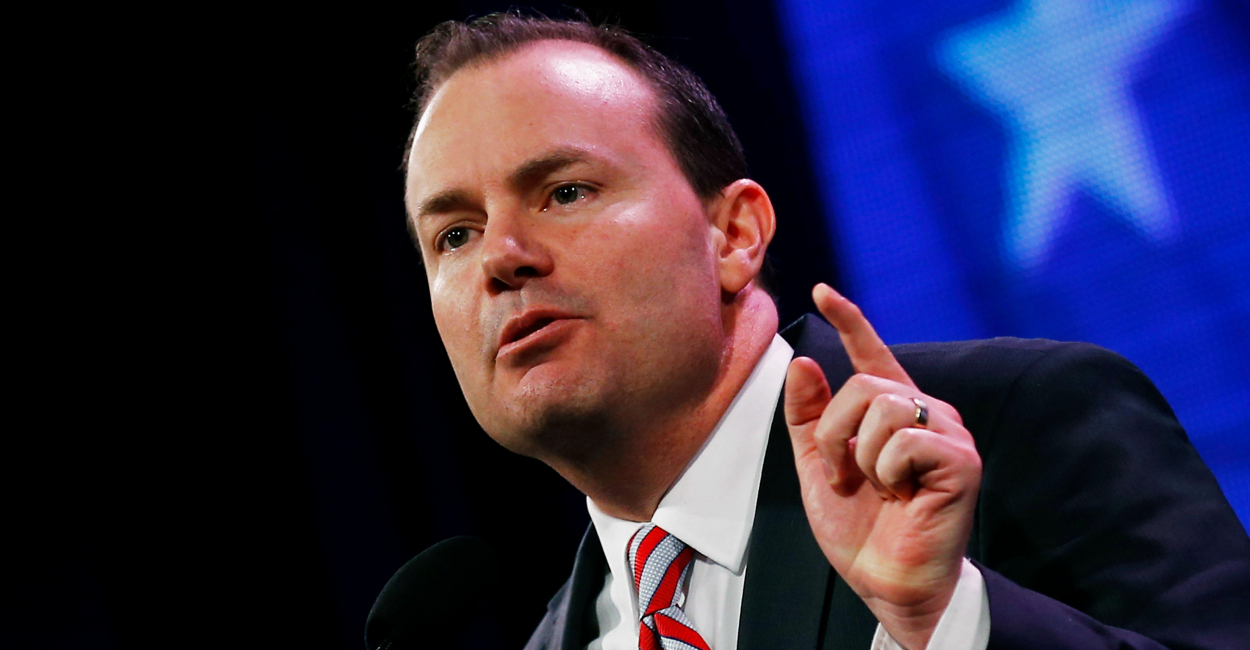
Sen. Mike Lee. (Photo: Jim Young/Reuters/Newscom)

For nearly a century Washington has been sapping Congress of the legislative powers guaranteed by the first line of Article I and creating what Madison warned against: “a gradual concentration of the several powers in the same department.” This chapter tells the story of how we got here—including the Constitutional Conven­tion’s resounding rejection of the brilliant but misguided Alexander Hamilton’s proposal for an American king and ending with short­sighted choices by Congress, the courts, and even the citizenry that have combined to undermine the first article of the Constitution and produce something very much like a monarchy.

Since the advent of delegation to executive agencies, this cycle has repeated itself hundreds—perhaps thousands—of times. Congress­men claim credit for passing a statute with lofty promises, such as stabilizing the market for farmers. Then, in the face of their constit­uents’ criticism of an agency-made policy that harms them by ful­filling those promises, congressmen criticize the policy without having to actually vote against it.

Consider the costs of reducing air pollution. The Environmental Protection Agency’s clean-air regulations cost Americans tens of billions of dollars every year. They result in higher electric bills; fewer jobs and lower wages for coal miners, car makers, and other workers; and less value for anyone who has invested (either directly or through a mutual fund or retirement plan) in a company that pro­duces or uses energy—in other words, almost any company in America.


Environmental Protection Agency Administrator Gina McCarthy. (Photo: Jim Lo Scalzo/Newscom)

For good reason, we as a society have decided that this price (that is, the price of clean air) should be paid. But in imposing these bil­lions of dollars of costs, there are countless difficult decisions to be made—decisions that inevitably involve a balancing of the costs and benefits of each possible restriction and culminate in a determina­tion as to which costs are worth bearing and who will bear them. New power plants or old power plants? Car owners or electricity users? States that rely on coal or states that rely on natural gas?

While promising to reduce air pollution, the Clean Air Act an­swered almost none of these hard questions. It simply told the EPA to put whatever limits on pollutants the agency deemed “requisite to protect the public health” with an “adequate margin for safety.” Hardly anyone was against this law—until they became the ones who had to pay for it.


By declining to make hard choices in the act, Congress had empowered others to make those choices.

Among the most enthusiastic advocates for the law were New York’s liberal congressmen and their constituents. Opposing the bill before its passage would have been outright heresy at an Upper West Side cocktail party. But several years later, when the Clean Air Act was used to impose tolls on New York City’s bridges in order to increase funds for public transportation, city dwellers balked.

Sure, people in New York City wanted less pollution. Sure, im­proving mass transit would reduce automotive pollution. But tolls on bridges? That was going to hit New Yorkers right in their pocket­books. After all, they lived on and around an island; how dare any­one charge them money to cross a bridge!

Of course, the tolls were the result of the law that New York City’s congressmen had championed. If liberal legislators had voted against the Clean Air Act, they might well have been voted out of office for opposing it. But by declining to make hard choices in the act, Congress had empowered others to make those choices. And when those choices were made in a way that hurt those leg­islators’ constituents, the congressmen feigned outrage. They even marched in protest across the Brooklyn Bridge. Only in the bizarre world of delegating legislative powers could members of Congress lead a march in protest against the consequences of a law they voted for.
Source